
Broadcom Stock Drops 10.4% as Chip Sector Slides
Broadcom shares slid 10.4% to $291.53 during a semiconductor market drop, approaching their 52-week low amid rising questions over data-center spending.
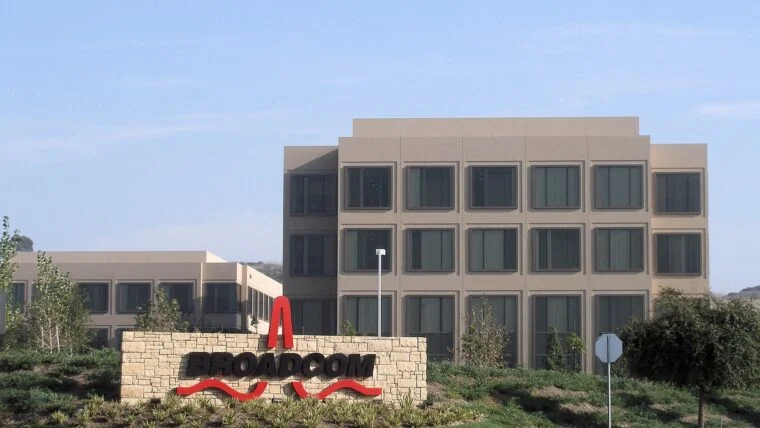
Broadcom Inc. shares dropped 10.43% to close at $291.53 on Thursday as investors reduced holdings across semiconductor companies linked to artificial intelligence data-center construction. The drop brought the stock near its 52-week low of $289.96 and roughly 41% below its 52-week high of $495.
The decline coincided with a 12.3% drop in the Philadelphia Semiconductor Index and a 12.8% loss for the iShares Semiconductor ETF. Benzinga identified both drops as the sector's steepest single-session losses since March 2020. The Nasdaq 100 fell 6.4% in the same session.
Reuters reported that investors reassessed planned projects after U.S. midterm elections created expectations of stricter permitting, power limits and water restrictions in states selected for data-center development. FinanceFeeds reported that the broader market drop removed $2.5 trillion from Wall Street valuations.
Semiconductor stocks record wide session losses
Benzinga's closing records showed double-digit percentage drops across major semiconductor producers:
- Micron Technology fell 17.5%
- Advanced Micro Devices fell 17.3%
- Marvell Technology fell 16.4%
- Arm Holdings fell 13.1%
- Taiwan Semiconductor Manufacturing Company fell 10.8%
- Broadcom fell 10.4%
- Nvidia fell 9.3% to close at $181.60
Broadcom stock had closed at $351.81 on October 28, dropping more than $60 over eight days. The shares traded around $297.39 at 11:37 a.m. Eastern Time on Friday, up about 2% after earlier touching $310.
Data-center revenue projections
Broadcom's AI unit produces custom accelerators, known as XPUs, alongside networking silicon used to connect hardware clusters inside data centers. In its fiscal third quarter, the company posted $16.7 billion in AI semiconductor revenue, an increase of 221% from a year earlier, representing over half of its $29.6 billion total revenue.
For the fourth quarter, the company projected approximately $21.7 billion in AI semiconductor revenue, up 236% from the prior year, against total company revenue guidance of roughly $34.8 billion. If realized, AI chips would generate about 62% of fourth-quarter revenue. Chief Executive Hock Tan stated that the company targets roughly $115 billion in AI revenue for fiscal 2027 and about $230 billion for fiscal 2028.
Valuation benchmarks and analyst commentary
On October 29, FinanceFeeds modeled Broadcom share paths at $427.47 in a bull case, $333.63 in a base case and $282.82 in a bear case, based on 90 prior daily returns and the October 28 close. Thursday's close finished $8.71 above that statistical bear level.
Benzinga's analyst tracking system recorded an average price target of $508 on Friday, with 28 buy ratings and three hold ratings. Most of those targets were published prior to Thursday's trading session.
Chris Zaccarelli, chief investment officer at Northlight Asset Management, told Benzinga that initial weakness following earnings from Qualcomm and Arm broadened into wider selling, stating that sentiment shifted from belief that AI "changes everything" to worries about data-center construction constraints. Adam Turnquist, chief cross-asset strategist at LPL Financial, said the trade sustained significant technical damage. David Bahnsen, chief investment officer at The Bahnsen Group, expressed caution regarding purchases, stating technology valuations remained elevated after the Nasdaq drop.
Broadcom plans to issue its fiscal fourth-quarter and full-year 2026 earnings results after the market close on Wednesday, December 9, with an investor webcast scheduled for 2:00 p.m. Pacific Time.
News is for information only and is not investment advice. Trading forex and CFDs carries a high risk of losing money.